Episode 1: How to keep going when everything falls apart
In episode one of The Jamerrill Show, Jamerrill opens with a heavy but deeply compassionate conversation about how to keep going when life completely falls apart. Drawing from her own season of implosion, she shares how she survived an experience that, in her therapist’s words, was “not survivable”—and yet, she is still here. Rather than offering polished solutions, she walks listeners through the simple, stabilizing practices that helped her endure: gentle movement, walking for hours when needed, honoring tears, sleeping, feeding herself without perfection, and giving herself permission to choose ease. She reflects on learning to listen to her body, regulate her nervous system, and rebuild trust in herself one hour, one day, one month at a time. This episode is a steady reminder that healing is layered, imperfect is okay, and caring for yourself is not optional when everything else feels unsteady. It’s an invitation to take the next small step and have your own back while rebuilding your one life.
“I could still make taking care of myself be my number one job. And as moms and women, I know we can have guilt about that. But me taking care of my children’s mother is a gift to my children. “
JAMERRILL
Listen on your favorite platform
You can watch the full video episodes on my second YouTube channel, and the audio is available on Spotify, Amazon, and other podcast platforms. Apple Podcasts is pending and will be added as soon as it’s approved.
Key Takeaways
Keeping going doesn’t start with answers. It starts with stabilization.
When everything fell apart, she didn’t have clarity or language yet. What she had were simple, bodily anchors: movement, sleep, nourishment, and routines that helped her feel steady enough to survive the day in front of her.
Your nervous system matters more than your productivity.
Learning to regulate her nervous system—often without even knowing the terms at first—was foundational. Walking, crying, resting, and listening to her body weren’t weakness; they were wisdom.
You don’t owe your story in exchange for compassion.
One of the most important boundaries she learned: sharing details is optional. If someone requires your deepest wounds to be exposed before they offer kindness, they may not be a safe support.
Survival happens by stacking small wins.
She didn’t “get through everything” at once. She stacked hard hours into days, days into weeks, weeks into months—and eventually, into years. Every small act of care counted.
Taking care of yourself is not selfish, it’s essential.
Movement, food, rest, lab work, and medical support weren’t indulgences; they were oxygen masks. Caring for her body allowed her to keep showing up for the people she loves.
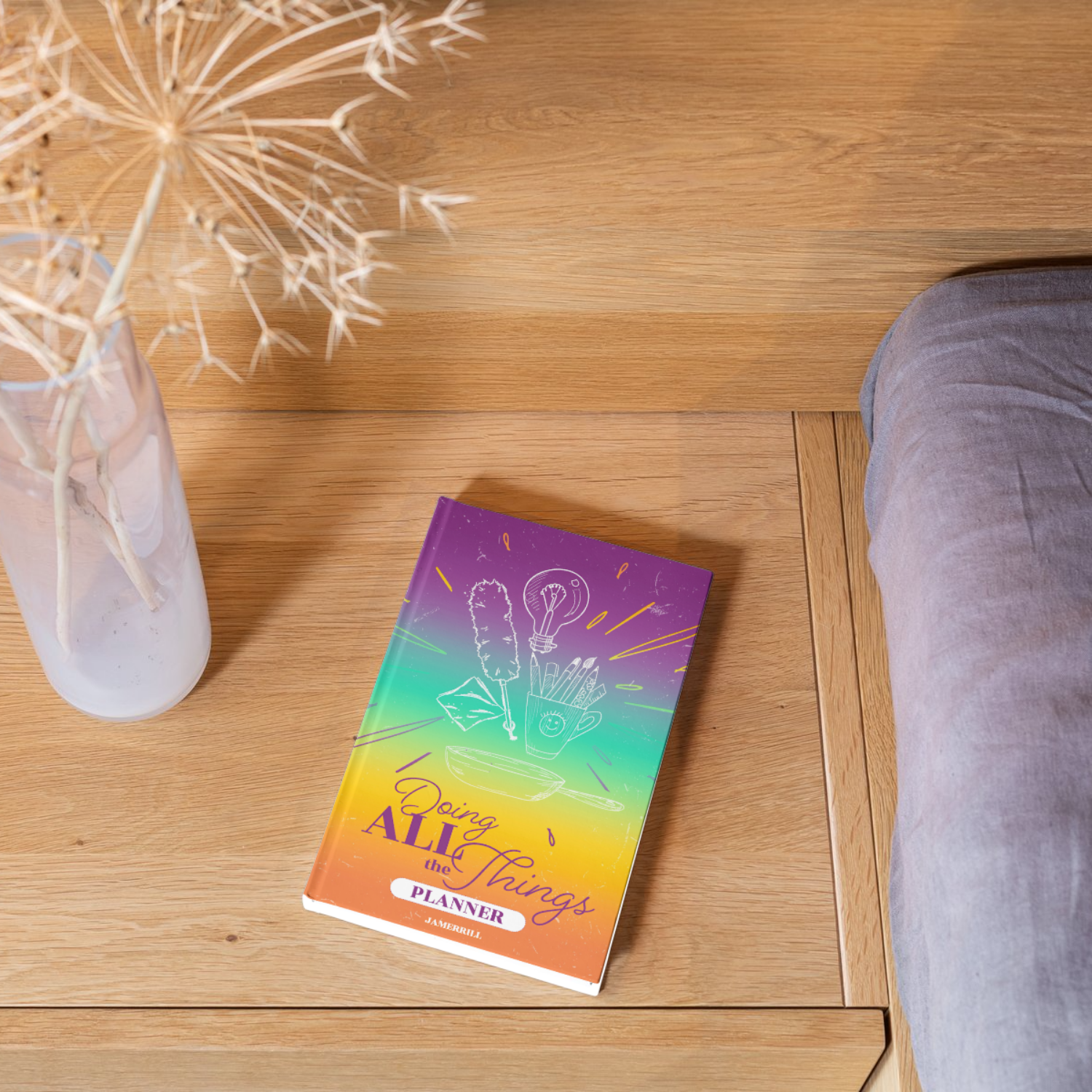
Your new best friend in the world of family life and personal organization: The Doing All The Things Planner!
This planner is designed with you in mind, to help you manage the whirlwind of your days and make every moment count.
Resources Mentioned
- Flying Free Podcast. Natalie’s podcast
- Trim Healthy Mama Cookbook
- Function Health
- Freezer Meal, Meal Planning Guides
Transcript
Welcome back again today, friends, for official episode one of the Jamerrill Show. I’m calling today’s episode, “How to Keep Going When Everything Else Falls Apart”. It’s a heavier episode right out of the gate, I know, but it’s definitely one of the topics that you all have watched me walk out on my main channel and I get so many questions from women about. So, I thought this would be the perfect spot to jump in. Obviously, I’m going to share parts of my story on how I learned to keep going when everything in my world fell apart. I’m sharing what helped me because I know many of you watching and listening are trying to keep going as well. So, I won’t be sharing every detail of my story, but I am going to share with you very simple strategies that helped me stabilize and find steady footing.
Even though I didn’t have language for much of what I was stumbling into and instinctively doing by learning to listen to myself, trust myself, and trust my intuition during that time. As I mentioned, many of these skills are not skills I was taught. I now know what my nervous system is. I now can name my feelings. I now know a lot more about feeling disregulated, bringing myself into a regulated state. I know about movement and processing. And I also know that my feelings are in my body for a reason, usually giving me information about something else that is going on in my world that I need to be aware of. And I also know that my intuition and my brain and my thoughts are there for a reason and I should listen to those. And of course, I am not a therapist. I am not an expert. I am just a real woman with real lived experience on a journey that I have been walking out over the last several years.
And during the season when my life imploded, so many of the people I thought that would always be in my life, the organizations, the support systems, the worldview and the framework that I had, all of those crumbled, some very quickly, some in an instant, some over days and weeks and months. And I was dealing with very hard, very unreal things. And many days it was constant and it was unrelenting.
And what I was going through—what my therapist has given me the language for at this time several years in, and she’ll even say this to me now—what I have gone through and what I’m currently living through is not survivable, but I am surviving it. And I hope that that’s an encouragement to you that over this extremely difficult season, my brain and my body again and again and again have seen that we have been building out. We, we as a team, the team that is my mind and my body, right? We have been building out, continually doing hard things, making it through, getting up and doing it the next day and taking care of my one life in the process. And when I take good care of myself, you deserve to take good care of yourself. When I take good care of myself, I can then take good care of all the people that I love.
And so during this worst implosion, and you can just insert your own life implosion here, right? One little side note I’d like to say: I had an Instagram commenter say this to me and she said that one of the things she learned in her own story is that she does not have to share her story with other people in exchange for compassion. And so I’ve had many people who want the intricate details of my story. And I always share through the lens of what my nervous system can handle at any given time. And I also say that to you for whatever your personal story is. You don’t owe people your story in exchange for compassion. If people are not going to be gentle with you and be compassionate with you and be kind to you unless you give them the raw, vulnerable, most delicate details from the depths of your soul, that may not be a person that you need support from anyway.
So early on when things were so very hard for me, we’re talking August 2023, September 2023, October 2023, just that last part of 2023. It was like a whole new universe. Everything I had known was gone. So my life was completely, just completely undone. And intuitively, just in my body, it felt like I needed to walk. I needed to move. And of course, I tried to return to routines and hold the day together and do some of the basic activities I did before, like make meals for my household and, you know, make sure laundry was being processed and those kind of normal mom life things. And very quickly I realized I just did not have—I did not have the capacity to focus on anything other than how was I going to get through the next moments and hours and even that day? How was I going to put one foot in front of the other and make it through? And maybe you know that level of darkness, maybe you don’t. But if you do, I definitely understand because I have been there.
So, instinctively, I started walking. I have always taken my herd of children on hikes up and down long roads around our farmhouse, field, wherever we were. And I’ve always been a mom to send my kids outside in the sunshine and play. So, there was something for me about being outside that made sense. And so in those first early days, I couldn’t even walk on my own property much at that time. I would go to a local park and I would walk two to four hours at a time.
Now, something I did have going for me at that time—and I know, and I know in different situations you may or may not have any support people with you at all—I did have my mom at my house. She is not another parent, but she’s a wonderful grandmother. And she would just look at me and say, “Why don’t you go to the park and walk?” I would be sitting in my chair or over—I would be somewhere and I would just be bawling, which makes sense. And so I would get in my car, I would change the location for that time, and I would just walk and I would cry. I would listen to music. I would listen to podcasts. I would listen to the sound of my feet, but I would just keep moving. And I didn’t have a lot of answers, and I didn’t know what the next day would bring, but I was getting endorphins during that walk. I would connect to some kind of hope. I didn’t understand yet that I was also doing that bilateral processing. I was engaging both sides of my brain, which was helping me process the devastation that I was living through every day. And it really did help me make it through so much.
So if I could—if I could walk for four solid hours, which again, I moved every day, but just like average movement for many, many people, I only got about 3,500 to maybe 5,000 steps a day on average. I can go through the health data on my phone for years and I can see many years where 3,000 steps a day is all I got. And I was jumping up to 10,000 steps a day. I remember one of my first pictures was like 9,000, 10,000, 12,000, 15,000. It just—it was the only thing in my life that felt good, and that’s why it needed to be done every day. And with that very fragile framework, I then, when I would get home, I would feel decent enough in my body and I would feel that the next thing I could do to build this little routine is I could get a hot bath. I could soak in some Epsom salts. I could cry some more in the bath, and I would be worn down enough to where most nights I actually got a full night’s sleep. So that was another mercy.
So very early on I connected to movement. I connected to very simple routines. I got that hot bath as part of my daily routine and I was getting sleep. All of these are pillars to help support you and that helped supported me when nothing else was supporting me in life.
One of the questions I received several times, and these are the kind of questions I want to get to here on the show, is, “Well, what about the woman who doesn’t have her 77-year-old mother at her house to be with the children of all the different ages, so the woman can go walk for two to four hours a day?” And I totally hear that. And I will say, even though my mom was there in those early weeks, which was wonderful, there were many times where she wasn’t here for the day. She was not here for the week. She maybe was gone for a few hours or, again, she travels and does all these horse things, you know, maybe she had a big equestrian thing and she’d be gone for eight days with that. And so what I would have done if she would not have been here in those early weeks is I would have had to have walked on my property where my children were playing and walk circles around them. And what I did at the times when she was gone is I walked circles outside with my children. And I will talk about more strategies to get movement in as a busy mom if you have no other support structures and you’re trying to get movement in for your body while raising a house full of kids. I have done it in lots of different ways and we will definitely get into answers for all of those questions, too.
So that early movement was helping me instinctively regulate my nervous system even though I did not have language for what I was doing yet. And I did not know how I was going to get through each day, but I showed myself. I stacked really hard hours and I got through a day. I stacked really hard days and I got through a week. And I remember getting through that first week and I was like, “Okay, did it. I can do it again”. Stacked the next week. Stacked the next week. Then got through a whole month. And then I began stacking months. And now I’m to the point where I’m stacking years. I’m not to the three-year mark yet, but I’m building out what will be my third year. So every month counts. Every month. And every year, every day, every moment in that stack counts. And I show myself again and again and again, I have been here 100% for myself. I have my own back. I can do these hard things. And that’s what you deserve, too. You deserve to know that you will be here for yourself and you will have your own back. And language that I learned from my friend Natalie Huffman is that I can save the girl that has my name. And she’s also the one that taught me the language about having my own back. And her podcast is the Flying Free Podcast. Natalie’s podcast was very instrumental and encouraging to me very early on. Many times on those two to four hour walks, I would just listen to her podcasts. I had different ones I had saved that were favorites, and I would just bend to them over and over and over again. And her episodes helped me not feel alone. And they also were my very first exposure to any kind of therapeutic language because again, in my background, feelings were not allowed. “Feelings lie to you and you can’t trust yourself”. So those were some of the mindsets I was coming from when everything fell apart.
And remember, when I talk about being fragile, feeling fragile, having a fragile framework of—of joy, even—it doesn’t mean that you’re weak or that I was weak. It just means that things are tender and things are new. And those new, tender things can be handled gently and with honor and with care.
And also early on I learned, again, my—my focus in—in my whole adult life, my whole focus had always been taking care of everything and everybody else, which is why I was the woman, as you can see on my main YouTube channel videos. You know, I had several times I was hospitalized in 2021 and 2022 with my right kidney with an E. coli infection, with a lot of havoc happening in my own body, and a big part of that came from all that I was pouring out into others and I was not pouring back into myself in any way. And I was doing the classic thing that so many of us are taught, is that we pour our life out like a sacrifice for other people. But at the end of the day when the framework of that falls apart, I found I didn’t have much to hold on to to take care of me and help me make it through.
So, besides the movement and the hot bath and the tears— and those tears can be honored, too. Those tears were helping me process those raw emotions. And not that I don’t have a variety of emotions in my body that still need to come out and I still need to—to look at and face and feel those and let them flow through me often, but all of the—the crying that I was just doing every single day was helping give all the sadness in my body someplace to go. And that’s also okay to spend days and weeks and months and years crying and letting that flow through our bodies, honoring it for what it is. It is sad and we can’t keep that sadness locked up in us because that can affect our health in many other ways.
So then the other self-care thing I had to do for myself, again, besides the walking and the hot bath and the sleep, was I had to feed myself. Okay. And of course, I’m a woman who I have built an over 100 million view YouTube brand and Shopify store and whole other food blog. I’ve done a lot of food things for many years. Now, I will say what helped my household when life imploded is I did have freezers full of freezer meals. We had our basics. We had our spaghetti sauce. We had sourdough bread frozen. I remember I was still trying to film, although I could hardly function. But I remember taking—I had frozen some egg roll in a bowl and one of my first videos trying to figure out how I was going to handle life as I was, uh, I was cooking the egg roll in the bowl from the freezer in my big cast iron pan. Um, we had a good base of freezer meals.
And also I had a structured way I had been eating, and if you’ve been with me for a while, you know I—I am the number one fan girl for Trim Healthy Mama. Okay, I love them. Their cookbooks have been my best friends. Their cookbooks have been with me through so many seasons in life. I have read their cookbooks like novels. I am not—I am not joking when I say that. I—I am just—I am just a super fan. And I had some things happen with my health, little side note, and I had to even adjust and tweak the way that I love to eat, which was their plan, which I ate for years. I had some things to support my health I had to do that was different from their plan. And I just—that was another thing I—I cried. I had to cry and grieve, and we’ll get into that more as I share more about health and weight loss and other other paths on this journey that I’ve been on and what I hope is help for you in finding your own bio-individual needs and what you need to do to help support your body through all seasons of life, too.
So there were times that I would put a butternut squash in the slow cooker and I would eat the spaghetti sauce with my family. But even putting the spaghetti squash in the slow cooker for myself, that was hard. That was really hard. And I had also a whole new season of life. Like a lot of appointments out, a lot of things I had to go to, a lot of things that needed handled that was—felt like I had weeks where I was running every day, but I still had to eat. And so I just got even better at eating out and staying on my plan and letting that just be something else I did on purpose for myself. I would go through Hardee’s and I would get the double bacon cheeseburger wrapped in lettuce. I would call my little Chinese food restaurant when I was going through town and I would have them do steamed chicken, steamed broccoli, steamed rice, no sauce, just something, you know. I—I can get the little grilled nuggets at Chick-fil-A and the fruit cup and I think they had the side salad then. I just—I just let myself eat out when I needed to, which many weeks, I mean, sometimes that—that would be my food for the day is whatever I had whenever I was out. Even doing things like taking an Egglife wrap and putting meat and cheese and some lettuce at home, that was hard for me. So just recognizing, okay, if this is hard for me right now, I have an answer. I can still eat. I can’t put too much thought into prepping anything with my hands to feed myself. And that is okay. I gave myself permission.
Now, working on my third year now, I do not eat out multiple meals a day. I might eat out once a week, maybe twice a week, many times now, not at all. I have a lot of good systems in place at home for myself that support what my body needs right now. But at that time, I could not—I could not put that thought into it for myself. So, permission slip. If there’s something you cannot put your brain power into because you’re already dealing with so much, if you have an easier way for you, do that. It is okay.
Once our freezers full of freezer meals left, we—we didn’t have people bringing us meals. We—we didn’t have people checking in on us. There were no casseroles that came to my house. So what I did, and I was also not back in the place where I could cook for myself or—well, we know I couldn’t cook for me, but I also was not in the place where I could do big meals because I still have a large household here. I still have people who need to eat and the freezer meals I had were a good base for a good 8 to 10, 12-ish weeks and then after that I was hoping that I would be able to get back to cooking more. Obviously the teens and such at my house, you know, everyone grew in their cooking skills during that time. Everyone learned how to do sheet pan chicken and do our root vegetables and everyone got really good at making their own breakfast sandwiches.
But also during that time, another permission slip that I gave myself is those Costco lasagnas. At the time, I think you could get like two for $16. So when I would go to Costco, I would get like four to six lasagnas and I would know, well, that’s probably three dinners coming up that I don’t even have to think about. There may be some leftovers for lunch. We have that. And I bought freezer meals. I bought Great Value corn dogs when we needed them. I just let that help me and I let that help us. And I learned more day to day. And of course I’m better at this now. I—I see it better now. So I hope that encourages you. But I was learning there was very little in life I could control. But there were a few things in life I had autonomy over. I could choose to move my body. I could choose to nourish my body. I could choose to get dressed every day. And I could also make choices to support my body. So I got my sleep at night, which again, my movement was the big key so that I could sleep at night.
Another thing that I had done during that time which was to support myself. Let this be a message in a bottle to you. I learned more about the power of having my lab work done whenever I had all this stuff with my body was crashing in 2021 with my kidney and all of that. And so one of the first things I did in fall 2023 is I had all my lab work done I could possibly have done to figure out where I was and what kind of support my body needed to endure the barrage of stress that I was suddenly under every day. And I was walking out, just like we hear on the airplanes, right? To put your own oxygen mask on first and then you can help others. And slowly learning how to save myself allowed me to be present to help other people in my life.
And so with me in my journey, my walking in about 8 to 10 weeks naturally progressed to running. I’m going to do a whole episode on that for you because again, questions that I get is, “When do I start running? How do I go from walking to running?” And women have these questions for me. And so I will just tell you what my experience has been in great detail. But for me, running came naturally. I listened to my body. I had primed the pump with that good consistent walking every day. And when it was time to run, my body was asking for it. And for you, it—it doesn’t have to be running. I think walking, if you are able to walk, there is so much good research about how gently and consistently walking does so many great things in our body in regulating our nervous system and helping us process thoughts.
I purposely in the morning will get outside and walk. I do, you know, hook, line, and sinker, midlife perimenopausal woman. Uh, you know, I’m—I’m out in my 10 lb weighted vest. I have added these layers over time. You pick one or two of these things. Pick what feels right for you. But I walk in the morning without my glasses on because I always either have contacts or glasses on and I just let my—my eyes absorb natural light which helps release natural melatonin in my body and helps my body reset properly. So I do get rest again that night.
And I have learned if I am feeling upset in my body, if I’m feeling anxious, if I’m feeling worried, I—I feel my feelings now. So they—they must—they must be looked at and dealt with. But many times, even if I can just take a 15 to 20 minute walk, I will feel better. Many times when I walk the—my brain finds the answer to what it’s looking for or it’s just able to pack that concern and be like, “Okay, well, we were feeling this and now we actually feel pretty good about it. So, I’m just going to put it over here and we’re okay”.
And back to the importance of lab work. And again, I’d love to do a whole episode with that. And maybe eventually we can have my doctor on here and some other medical experts besides just a woman who has seen it work firsthand. But some people have said to me, “Oh, you were on the, you know, the stress diet. You—you lost that 70 pounds because you were so stressed out”. Well, no, that’s not my story. My story is I had extremely high cortisol. High cortisol leads to high inflammation and that leads also to insulin resistance. I also had an hs-CRP of 5.7. That was after losing 60 pounds, and that’s high risk for heart attack and stroke. So this chronic stress has caused havoc in my body. But I believe because of my consistent and slow and gentle movement and the way that I have nourished my body and taken my supplements, I have my lab work done every six months and we tweak and make adjustments from there.
And I have been healing in layers and I believe that has helped me save myself. And I believe that our bodies can heal with support. Now I do know we don’t get to choose what our bodies are going to do. If our bodies have held a lot, if there’s been a lot that we’ve been dealing with and holding on to. You know, I think I heard a statistic recently, I believe 80% of autoimmune diseases are in women. As women, we have a lot that we are handling and a lot of that shows up in our bodies and our health. And I understand that we can do the movement. We can eat how we think is right. We can take the supplements. We can do the things. We can even lose the weight and we can see our bodies do things we don’t want them to do. After losing 60 pounds, I didn’t want to be high risk for heart attack and stroke after all the healing I had done, but I was. And I had to take a whole other year and do another deep dive to heal other layers to reverse my pre-diabetes and also reverse my insulin resistance. But I believe because of the support I was able to give myself by focusing on my health, even with all these other wild things going on around me, I could still make taking care of myself be my number one job. And as moms and women, I know we can have guilt about that. But me taking care of my children’s mother is a gift to my children. And my body still might do things that I don’t want it to do. Even though I’m nurturing it, I’m supporting it, I’m caring for it, my body has been through a lot. I have another layer of healing that I’m currently focusing on. Even though I’ve accomplished a nice list of goals slowly over time, I now have some new layers that I have to focus on. And that’s going to be my 2026 focus is to try to bring those areas into alignment.
So, my very practical steps for you, it’s—it’s basically a list. You don’t have to do it all. Again, pick one or two things that feel right to you when—when everything in life feels like it’s falling apart, but you have to take care of yourself and keep going. It is okay for life to be imperfect for a season or for several seasons. Imperfect is fine. Imperfect is okay. And projects can wait. And “pretty okay” is pretty good. A lot of people are not pretty okay. And if you can be pretty okay, that is good enough.
Try taking yourself for a walk. Walk 10 to 15 minutes. If you have a yard full of kids, what I’ve done many times, I walk circles around the trampoline. Get yourself a watch. If you like, if you’re like me and you like data, I like to see those steps. I like to see the miles stack. You can get a lot of miles in walking circles around the trampoline. When I take them to the children’s museum, I set my watch to walk and I purposely try to get as many steps in around them as I can. That’s more than a 10 or 15 minute walk. But that is how you can build that practice into your daily life over time.
Drink your water. Eat your protein. If you can reduce sugar and take out white flour, that’ll go a long way for you. And even things like for your supplements, you know, I got—I got one of those big pill organizers with the big boxes. And I just at a week at a time, I go through my morning supplements, my evenings—evening supplements. Probably takes me 10 to 15 minutes once a week, but I just do that for myself. Give to myself so it is done every day.
Consider getting blood work done on yourself if you haven’t already. There’s a fantastic offer through Function Health and I will put the link in the show notes. I’m pretty sure it gives you lab work twice in one year and it’s the one-time price is much cheaper than usually what it costs to have lab work done one time. They give you all the test and supplements that would go along with it and it’s—it’s a really nice deal.
And also give yourself permission to rest more than you think you should. I know that people, and again we’ll get back—we’ll get to this more in the walking and running episode, specifically how it’s just a big part of my story, so we will talk about it. So many people will want to know how I get all my movement in and will want to know, you know, when do I rest and those kind of things. I don’t walk fast. You know, I might have a pace of 2.2 miles an hour, sometimes 2.7. I enjoy myself. I am not walking to win a race. And even when I run, I’m not—I’m not running fast. I’m not running a 9-minute mile. I can run a 10-minute mile. I can do it. But I don’t do that pace every day. A lot of what I do is slow and steady and builds over time.
So this is your reminder. You deserve rest. You deserve nourishment. You deserve care. You are allowed to care for yourself. And the only person who’s going to save you and take care of you consistently, the only person who you will always be with: is you. You will always be there to care for yourself. So you should start today and ask yourself, what is it you need to take care of yourself and your one life? I appreciate you. Thank you so much for being here with me and I’m glad you’re here. Again, head to Jamerrill.com for our show notes and all the resources I mentioned today.